
If you’re planning a job site and trying to figure out how many portable toilets you actually need, the answer isn’t a guess, it’s a federal regulation. OSHA sets a specific minimum ratio of toilets to workers on construction sites, and falling short of it can mean citations, fines, and a crew that loses time walking or driving to find a working restroom. The good news is that once you understand the rule, it’s simple to apply. This guide breaks down exactly what OSHA requires, where the rule has exceptions, and why the legal minimum often isn’t the number you should actually plan around.
The Short Answer: OSHA’s Toilet Ratio for Construction Sites
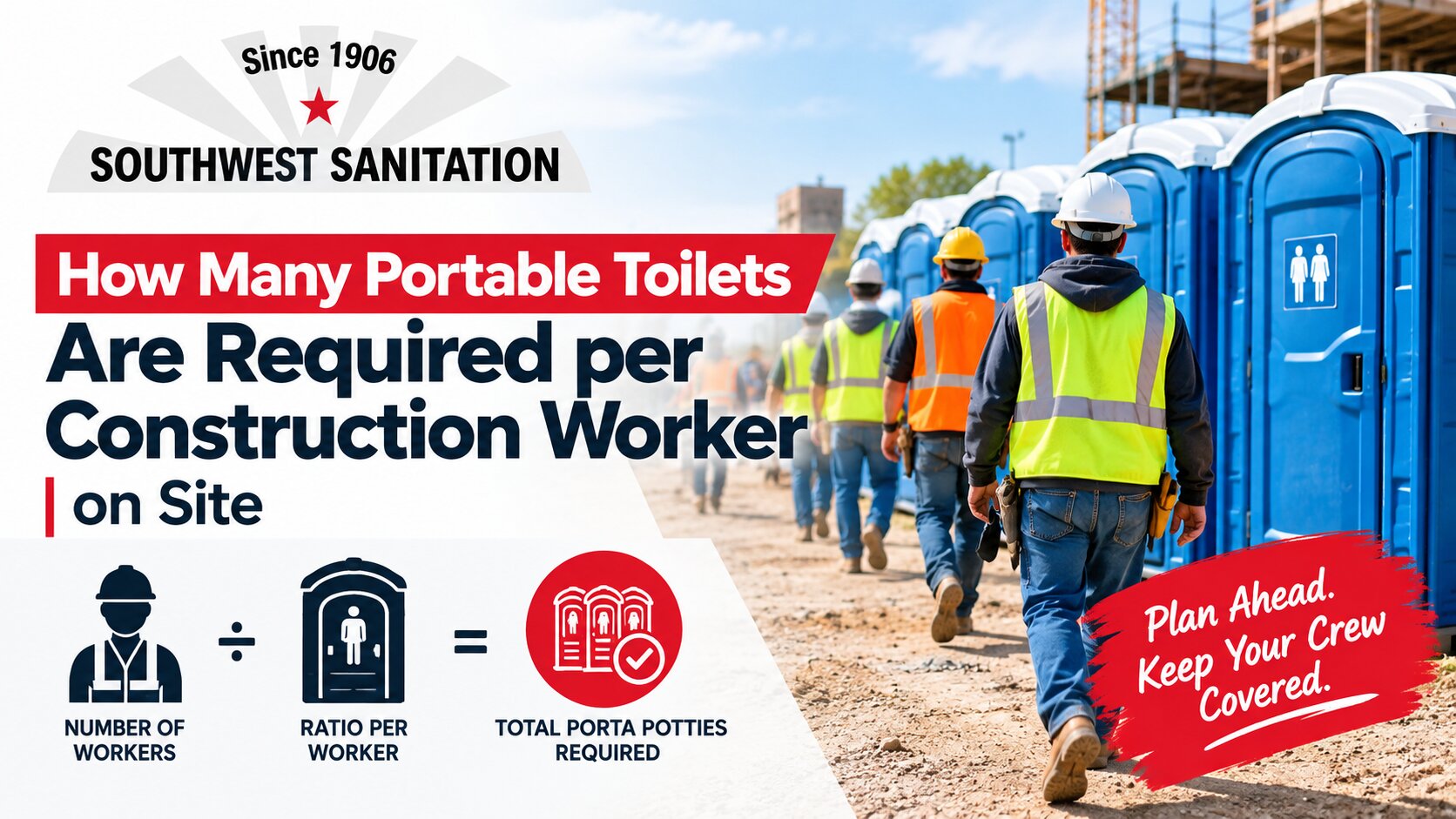
OSHA’s sanitation standard for construction, 29 CFR 1926.51(c), sets out the minimum number of toilets required based on how many employees are on site at the same time. The requirement scales in three tiers:
- 20 or fewer workers: 1 toilet.
- 21 to 200 workers: 1 toilet seat and 1 urinal for every 40 workers.
- 201 or more workers: 1 toilet seat and 1 urinal for every 50 workers.
This is measured against the maximum number of employees on site at any one time, not your total headcount for the whole job. A project that runs 60 workers on a single shift needs enough units for 60 people, even if the full job employs 200 people across multiple shifts and phases.
What Counts (and What Doesn’t) Toward the Minimum
A few details in the regulation trip contractors up more often than the ratio itself. Urinals don’t count as a substitute for toilet seats; the required toilet seat count has to be met separately.
A unit that’s out of service, overflowing, or otherwise unusable doesn’t count toward your minimum either, even if it’s physically present on site. If you’re relying on a set number of units to stay compliant, they need to actually be functional and serviced on a schedule that keeps them that way, which is one more reason routine servicing matters as much as the initial delivery count.
The Mobile Crew Exception
OSHA makes one notable exception: crews that move between locations throughout the day and have transportation readily available to a nearby toilet facility, generally interpreted as one reachable within about 10 minutes, aren’t required to have a dedicated unit at each stop.
This typically applies to field crews such as utility line workers or landscaping teams that work multiple short-duration sites in a single day rather than staying at one fixed location. Most general construction sites, where a crew works the same location for the length of a shift or longer, don’t qualify for this exception and need on-site facilities.
Why the Legal Minimum Isn’t Always the Right Number
OSHA’s ratio is a floor, not a recommendation. If your crew works long shifts, has overlapping breaks, or includes workers handling food or materials that require frequent handwashing, planning to the bare minimum often creates bottlenecks during peak times like the start of shift, lunch, and end of day.
The voluntary ANSI/PSAI Z4.3 standard for portable sanitation is a useful benchmark here, since it generally recommends servicing and placement practices that go beyond OSHA’s floor. If you’re weighing exactly how many units and what type fits your specific project, our guide on how to choose the right porta potty for construction sites and events walks through the practical side of that decision in more detail.
Match the Unit Type to Your Crew, Not Just the Ratio
Meeting the OSHA ratio is only part of the picture. You also need the right type of unit for the job. Our detailed breakdown of different types of portable toilets and their uses covers the full lineup, but for most active construction sites, Standard Porta Potty units meet the baseline requirement reliably and affordably. If your crew includes or serves workers or visitors with mobility needs, you’ll also need at least one ADA Porta Potty on site, since a standard-only setup doesn’t satisfy accessibility requirements even if it technically hits the OSHA headcount ratio.
Don’t Forget the Handwashing Requirement
OSHA’s sanitation rule doesn’t stop at toilets. Construction sites are also required to provide handwashing facilities with soap and running water; hand sanitizer alone doesn’t satisfy the standard.
Pairing your toilet units with a portable hand wash station covers this requirement and keeps the line at the restroom itself moving faster, since not every visit needs a full unit.
What Happens If You Don’t Meet the Minimum
OSHA sanitation violations are treated as a serious category of citation, and penalties can run into the thousands of dollars per violation, with figures cited publicly as high as $16,000 depending on the violation type and history.
Beyond the fine itself, an under-resourced site sees real productivity losses: workers walking or driving off site to find a restroom, longer breaks than necessary, and lower morale on crews that feel their basic needs weren’t planned for. None of that shows up on a compliance checklist, but it shows up in the schedule.
Planning for Multi-Shift and Multi-Phase Projects
Larger jobs rarely stay at one headcount for the whole duration. A site might start with a small crew doing grading and excavation, scale up to 80 or more workers during the framing and finishing phases, and taper back down before closeout. Since OSHA’s ratio is based on the peak number of workers on site at any one time, your unit count needs to flex with the project, not stay fixed at the day-one number.
It’s worth building a rough schedule of expected headcount by phase before the job starts, so you can plan unit additions and removals around the actual peaks instead of either overpaying early or scrambling to add units once a phase ramps up.
Multi-location projects add another layer: if your crew splits across two or more active sites at once, each site is evaluated against the ratio independently, since workers at one location can’t rely on a toilet count provided somewhere else.
Quick Reference Checklist
- Count the maximum number of workers on site at one time, not your total project headcount.
- Apply the OSHA tier: 1 unit for 20 or fewer, then scale by 40s up to 200, then by 50s beyond that.
- Confirm every counted unit is currently sanitary and functional, not just present on site.
- Check whether your crew qualifies for the mobile crew exception before assuming you need fixed units.
- Add at least one ADA-compliant unit if the site includes workers or visitors with mobility needs.
- Pair units with a hand wash station to meet the separate handwashing requirement.
- Plan above the legal minimum if shifts are long or breaks overlap, to avoid bottlenecks at peak times.
Get the Right Count for Your Site
Working out the exact number and type of units for your project doesn’t have to fall entirely on you. Southwest Sanitation has served construction sites and events across the Phoenix area with clean, reliable, code-compliant portable restroom solutions. If you haven’t rented with us before, here’s how the rental process works from booking to pickup.
Browse the full porta potty rental lineup, or get a free quote and our team will help you land on the right unit count for your crew size and shift pattern. Questions about your specific site? Contact us and we’ll walk you through it.